Atym Hub
The Atym Hub is the centralized control plane for deploying, operating, and securing applications across fleets of distributed edge devices. It provides the services and interfaces required to manage the full application lifecycle—from build and deployment through monitoring and updates—at fleet scale.
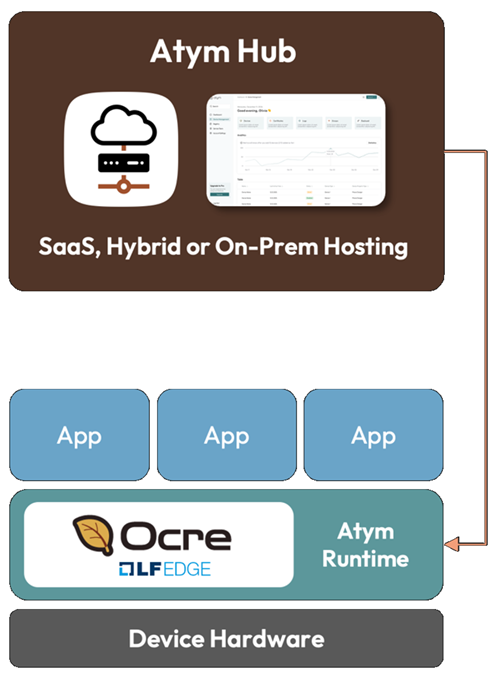
Atym Hub exposes its capabilities through a command-line interface (CLI), web-based UI, APIs, and CI/CD integrations, allowing teams to integrate edge application management into existing development and operational workflows. It also includes an OCI-compatible container registry and build services to support end-to-end application delivery.
Key Capabilities
At a high level, the Atym Hub provides the following capabilities for orchestrating containerized applications on edge devices:
-
Ahead-of-Time (AoT) Optimization - The Atym Hub automatically performs Ahead-of-Time optimization of application workloads as part of the deployment process. This occurs automatically during deployment, ensuring applications execute with near-native performance on target devices, while allowing developers to maintain a single portable application artifact. The result is optimized execution without introducing additional complexity into the development workflow.
-
Incremental Application Updates - Applications are deployed and updated as independent containers rather than as part of a monolithic firmware image. Updates are downloaded and validated in the background while applications continue running, enabling smaller updates, faster rollout, and lower operational risk. This allows updates to be applied without rebooting devices or interrupting application uptime.
-
Live, Centralized Observability - The Atym Hub provides live, centralized access to application logs and runtime information across device fleets. Logs can be streamed in real time to the Hub or forwarded to external logging and monitoring systems, enabling remote troubleshooting, health monitoring, and diagnostics for devices deployed in the field—without custom instrumentation or physical access.
-
Cloud-Native Operational Model - Atym adopts the same application lifecycle and operational model used in modern cloud-native environments and applies it to constrained edge devices. Applications are packaged and managed as OCI-compatible containers, integrating naturally with existing build pipelines, registries, and automation tooling. This allows teams to extend familiar DevOps practices—such as CI/CD, versioned deployments, and rollback—to the edge without redefining their workflows.
Command Line Interface
The Atym CLI provides direct access to Hub functionality from the command line, enabling developers and operators to build, publish, deploy, and manage application containers across devices and fleets. In addition to interactive use, the CLI is designed for scripting and automation, making it well suited for CI/CD pipelines, operational tooling, and large-scale fleet management.
- For installation and setup instructions, see CLI Installation.
- See the full CLI reference guide here.
Web UI
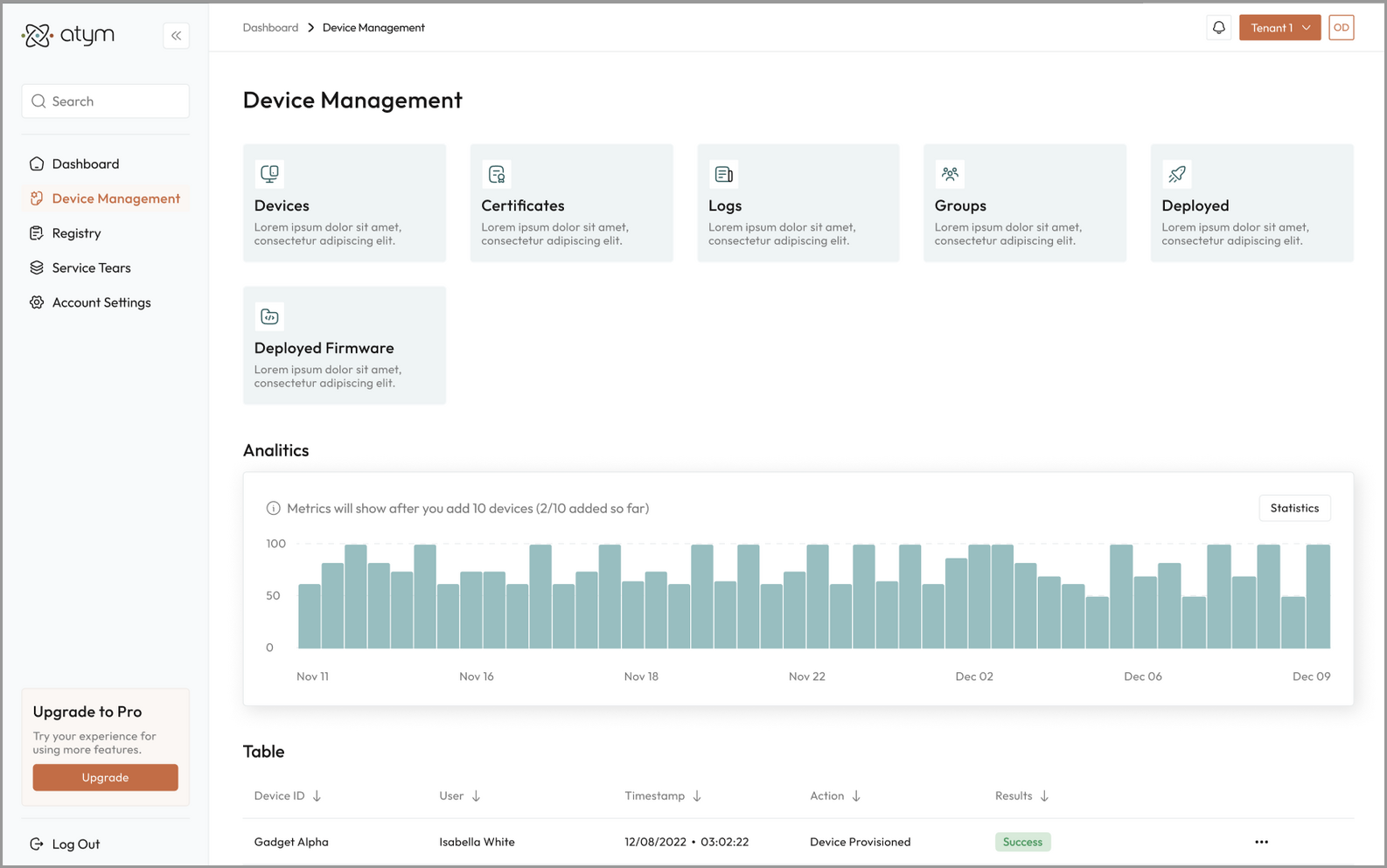
Atym provides a web-based user interface wherever the Atym Hub is deployed, regardless of hosting model. The UI offers a more accessible and user-friendly way to interact with the platform and is designed specifically to support day-to-day operational workflows such as monitoring device fleets, managing deployments, and investigating issues in the field.
For OEMs and solution providers, the Web UI can also be rebranded or embedded to provide an integrated operational experience without building custom management tooling.
Hosting Models
The Atym Hub is built using a modern, cloud-native architecture and is portable across multiple hosting environments. It is offered as a SaaS by default, with support for private cloud, hybrid, and on-prem deployments to meet different operational, regulatory, and data residency requirements.
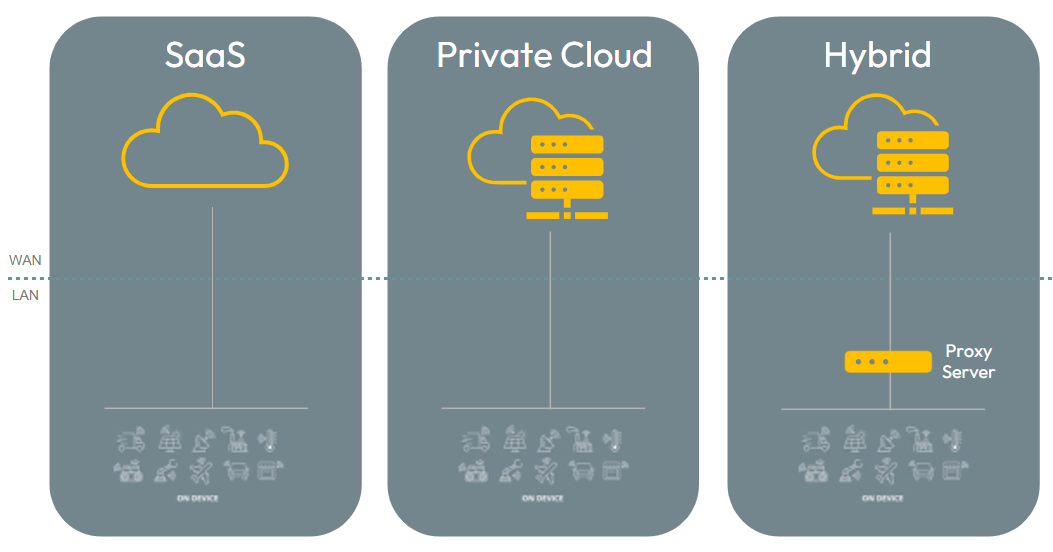
In addition to direct use by development and operations teams, the Atym Hub is designed to be integrated into OEM platforms and backend systems through comprehensive APIs. This allows connected product vendors to embed Atym’s orchestration capabilities into their own solutions, while individual developers or teams can use the Hub as a managed control plane for deploying containerized workloads to edge device fleets.