Atym Container Model
Atym containers define how applications are packaged, distributed, and executed across edge devices. They allow developers to build applications in any language that can compile to WebAssembly—including C, C++, Go, and Rust—while preserving the familiar container concepts used in cloud-native environments.
Because containers are binary artifacts rather than source-level integrations, existing applications—particularly C and C++ codebases—can be repackaged into Atym containers without restructuring monolithic firmware builds. This dramatically simplifies application lifecycle management while enabling modular, component-level composition on embedded systems.
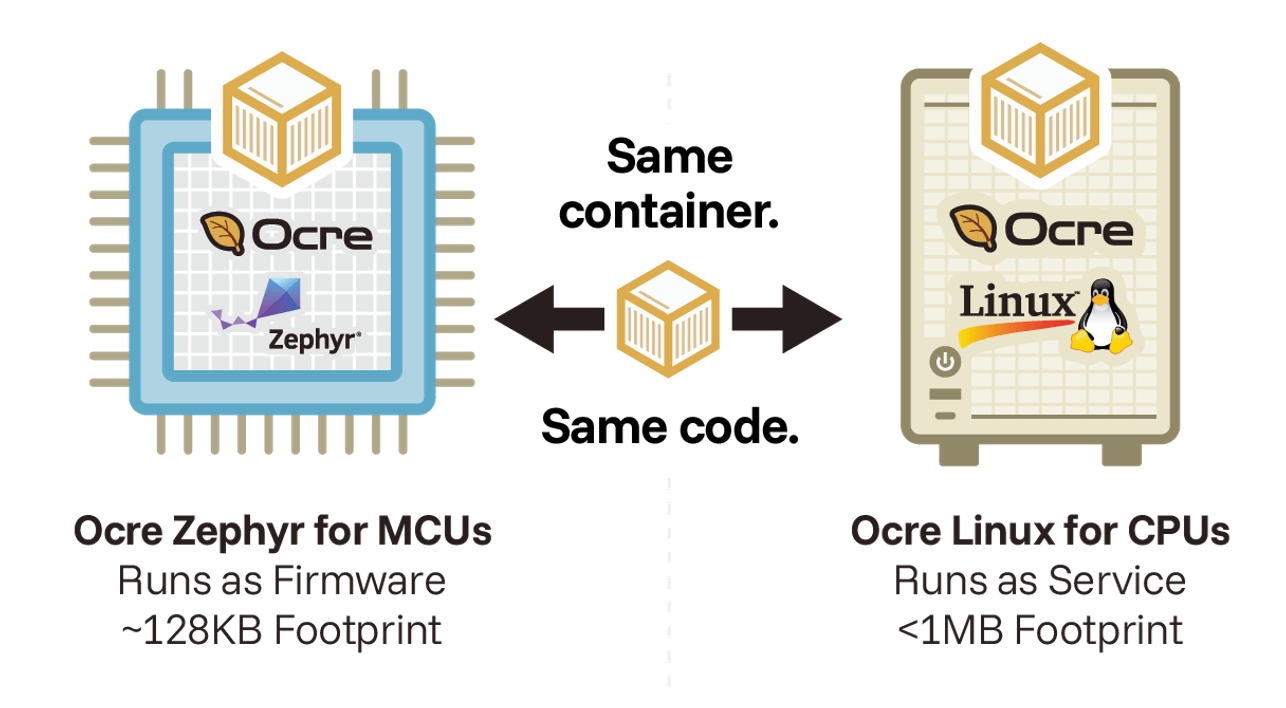
Atym containers follow the Open Container Initiative (OCI) image model and are compatible with standard OCI image formats and registries. The same container images can be built once and deployed across different runtime variants, including both Zephyr- and Linux-based devices, without modification.
Through the Atym Hub, containers gain additional platform capabilities such as automatic performance optimization, secure authentication and certificate management, background updates, and centralized observability. This allows teams to apply proven container workflows to constrained edge environments while maintaining near-native performance and strong security guarantees.